How to Fix Sun Damage: A Guide to Smoother, Brighter Skin
Table of Contents
How to Fix Sun Damage: What Actually Works
How to Fade Sun Spots and Even Out Skin Tone
Your Skincare Routine for Sun Damage: A Step-by-Step Approach
When to See a Professional About Sun-Damaged Skin
Can Sun Damage Be Reversed?
What Actually Works for Sun-Damaged Skin Treatment
Frequently Asked Questions
Last Updated: October 16, 2026
How to Fix Sun Damage: What Actually Works
You cannot fully erase sun damage, but you can visibly improve it. That is the honest starting point, and it is where most guides get vague. The Skin Cancer Foundation's July poll of more than 2,300 people found that 63% reported five or more sunburns, a known melanoma risk factor (EXTERNAL_LINK: Skin Cancer Foundation summer sun safety update | skincancer.org).
So how do you fix sun damage? Stop new damage with daily protection, then encourage renewal with ingredients that speed up cell turnover.
Sun-damaged skin needs a sequenced plan, not a pile of products.
What moves the needle: daily SPF, retinoids, brightening actives, professional treatments for texture and deeper pigment, and realistic timelines, most changes take 8-12 weeks.
Watch Out The biggest mistake is starting a strong retinoid and an exfoliating acid in the same week. The result is a wrecked skin barrier, redness, and peeling that sets you back a month. Add one active at a time, two weeks apart.
How to Fade Sun Spots and Even Out Skin Tone
Fading sun spots comes down to two jobs: slowing new pigment and lifting existing pigment.
KARE 11
The most reliable options: vitamin C in the morning, niacinamide, azelaic acid, retinol or prescription tretinoin, and lightening agents like hydroquinone used under guidance.
The American Academy of Dermatology lists prescription retinoids, chemical peels, laser resurfacing, intense pulsed light, microdermabrasion, and cryosurgery among the ways dermatologists treat sun-damaged skin (EXTERNAL_LINK: AAD guide to treating sun-damaged skin | aad.org).
Over-the-counter products handle tone and texture; deeper pigment and rough patches usually need professional care.
Concern | At-Home Option | Professional Option | Typical Timeline |
Uneven tone | Vitamin C, niacinamide | Chemical peel | 6-12 weeks |
Dark spots | Azelaic acid, retinol | Intense pulsed light | 8-16 weeks |
Rough texture | Retinol, gentle exfoliation | Microdermabrasion | 4-8 weeks |
Fine lines | Retinol, daily SPF | Laser resurfacing | 12-24 weeks |
Loss of elasticity | Hydration, SPF | Skin resurfacing | 12+ weeks |
Pro Tip Apply vitamin C in the morning and a retinoid at night. Using both at night wastes the vitamin C's daytime protection and stacks two irritants on your skin at once.
Your Skincare Routine for Sun Damage: A Step-by-Step Approach
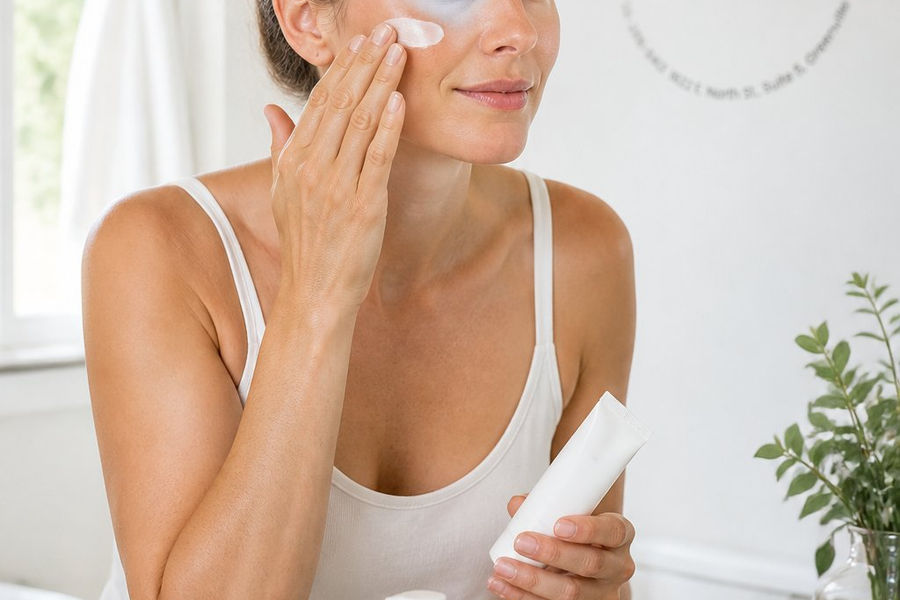
A skincare routine for sun damage works best when it is short and consistent.
Morning: rinse, vitamin C serum, moisturizer, broad-spectrum SPF 30 or higher.
Evening: cleanse gently, apply retinoid (start twice a week), follow with a barrier-repair moisturizer.
Weekly: one exfoliating session, no more, and skip the retinoid that night.
Key Takeaway Consistency beats intensity. A simple routine followed for 12 weeks outperforms a complicated one abandoned after two.
When to See a Professional About Sun-Damaged Skin
Some changes are cosmetic; others need a second look.
See a professional if you notice a spot that changes shape, color, or size; a sore that bleeds or will not heal; a new dark spot after age 40; rough, scaly patches; or any mole that looks different from the rest.
Those signs can point to precancerous or cancerous lesions, which sit outside cosmetic care. A licensed esthetician can flag them, but a physician makes the diagnosis.
For everything else, professional treatment options exist. The AAD notes that intense pulsed light, laser resurfacing, chemical peels, and microdermabrasion can improve visible signs of photoaging (EXTERNAL_LINK: AAD on sun-damaged skin treatments | aad.org).
Watch Out Never treat a changing or bleeding spot with an at-home peel or lightening cream. You can mask the problem and delay a diagnosis that matters.
Can Sun Damage Be Reversed?
Sun damage cannot be completely reversed. Jefferson Health states that the effects of sun damage cannot be undone entirely, though treatments may support collagen production and improve appearance (EXTERNAL_LINK: Jefferson Health on repairing sun damage | jeffersonhealth.org).
What you can do is reduce how visible it is. Collagen, pigmentation, and skin texture all respond to treatment over time: the damage is softened, and new damage is prevented from stacking on top.
What Actually Works for Sun-Damaged Skin Treatment
Sun-damaged skin treatment works best in layers, from prevention up to professional care.
Daily sunscreen. Non-negotiable. This is the only step that stops the clock.
One retinoid. Retinol or prescription tretinoin, applied at night.
One brightening active. Vitamin C, niacinamide, or azelaic acid.
Barrier support. Moisturizer and hydration keep the actives tolerable.
Professional treatments. Peels for what topicals cannot reach.
The CDC recommends shade and clothing alongside sunscreen to reduce sun-damage and skin-cancer risk, and the American Cancer Society advises protective clothing as well (EXTERNAL_LINK: CDC sun safety facts | cdc.gov).
Frequently Asked Questions
Can sun damage be repaired?
Sun damage cannot be completely reversed, but you can significantly improve its visible signs. A consistent routine with sunscreen, retinoids, and ingredients for hyperpigmentation can fade dark spots and smooth rough texture over time. In-office treatments like chemical peels can take results further. The key is protecting your skin daily while giving it the tools to renew itself.
How long does it take to see improvement in sun-damaged skin?
Most people notice subtle changes in 4 to 6 weeks with a dedicated skincare routine for sun damage. Dark spots may take 8 to 12 weeks to fade noticeably. Professional treatments can speed things up, but results still build gradually. Consistency with daily SPF is what protects your progress and prevents new damage from undoing your efforts.
What skincare ingredients can help improve the appearance of sun damage?
Retinoids, vitamin C, azelaic acid, and niacinamide are among the most studied ingredients for hyperpigmentation and sun-damaged skin treatment. Retinoids boost skin renewal, vitamin C brightens and defends against free radicals, and azelaic acid targets discoloration. Niacinamide supports the skin barrier and reduces redness. A professional can help you layer these without irritation.
BOOK
Comments